Woodhouse Mill, Todmorden
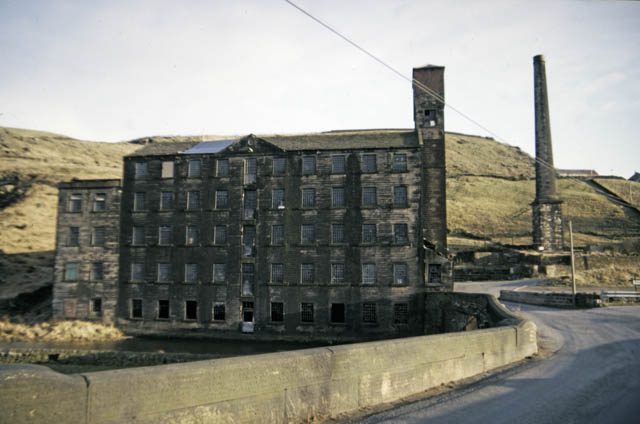
Extract from the Todmorden and Walsden website: Richard Ingham senior began as a worsted stuff maker before starting in the cotton spinning business at CASTLE MILL and then at CINDERHILL MILL. He died about 1810, leaving his three sons, Richard, John and William to continue. They traded under the name of Richard Ingham & Sons for many years after the death of their father before eventually becoming Richard Ingham & Brothers. About the time of the death of Richard senior, a third mill was added to the collection. This was Millsteads, and all three mills were located in the Castle Street area of Todmorden. In 1830, the three brothers bought a plot of land in the Castle Street area. Trading as Richard Ingham & Sons, they built Woodhouse Mill as a steam powered cotton-spinning mill in 1832. It faced onto the canal, with a tier of doors designed to take in goods directly from the boats. These doors were situated in the middle of the front wall. The hoist above these doors was attached to a small triangular pediment, which is inscribed 1832. The engine house and boiler house, together with the warehouse, were detached from the main building, as is the chimney. The mill was 5 storeys high, ten bays long by four bays deep. There was no weaving shed at Woodhouse, so initially all the weaving was put out to local handloom weavers. When its sister mill, Cinderhill, had a weaving shed added, the two mills ran in conjunction and home weaving was discontinued. In the 1850’s they added an extension to the side of the mill, 4 storeys high with a flat roof that carried a cast iron reservoir. John Ingham had responsibility for Woodhouse Mill, remaining at the helm until about 1860 when his sons John Arthur and William took over. John Arthur looked after the boilers and machinery whilst William took care of the paper work. By 1863, the mill had a 45hp steam engine and 2 boilers, each of 40hp. One of these boilers was new, but the other was 15 years old and recently patched up. The mill closed in 1960 and was left derelict for many years. The mill was made a Grade II Listed Building and became a possible candidate for restoration and conversion to a textile and industrial museum. However, in 1994 an accidental fire gutted the interior and left it without a roof and end wall. This put paid to any conversion, but more recently a businessman purchased it and has restored it faithfully to its former glory on the outside of the building, whilst converting the interior into residential apartments.